Tyrannosaurus skull fossil

Tyrannosaurus skull fossil

Tyrannosaurus (Tyrannosaurus) is a genus under Tyrannosauridae. The only effective species is the model species Tyrannosaurus rex or Rexosaurus rex. It is a large carnivorous dinosaur with a length of about 15 meters, a hip height of about 5 meters, and a weight of about 8 metric tons to 13 tons. The Maastricht order, which lived at the end of the Cretaceous, was about 67 million to 66 million years ago. It was one of the last dinosaur populations before the Cretaceous-Tertiary extinction event. Fossils are distributed in the United States and western Canada in North America, and the distribution range is wider than that of other Tyrannosauridae. Western North America in the late Cretaceous period is an independent continent of Larramidia.
Lianglong skull fossil

Lianglong skull fossil

Lianglong is a dinosaur belonging to the family Lianglong in the order Saurischia. The neck is long, the head is small, and the position of the nostrils is higher than the eyes; The front of the mouth has flat teeth, while the sides and back have no teeth; Strong limbs, short forelimbs, long hind limbs; The buttocks are higher than the front shoulders; Each palm has 5 fingers (toes); The tail is longer than the neck and gradually narrows towards the end, forming a whip like shape, with over 10 human bones in the middle. The name Shuanglianglong comes from two protrusions that protrude from the top of the human character bone, resembling double beams, and is commonly referred to as Lianglong. Living in western North America during the late Jurassic period. Living in groups, when there is a shortage of local food, they collectively migrate to distant places. Plant eating, feeding on leaves and ferns.
Skull fossil of helmet dragon

Skull fossil of helmet dragon

Corythosaurus, also known as Guanlong, Cockscomb Dragon, Helmet Headed Dragon or Helmet Headed Dragon, meaning "helmet lizard", is a genus of hadrosaurids in the subfamily Leucisaurinae. It lived in North America during the Upper Cretaceous period, about 75 million years ago. It has a duck like face and a high helmet like protrusion on top of its head, hence its name. Helmeted dragons have a gentle temperament and lack defensive equipment such as spines and claws, which means they can only rely on their sharp and developed visual and auditory organs to prevent predator attacks. It is a herbivorous dinosaur that mainly feeds on pine leaves, fruits, tender branches, and magnolia leaves.
Amorosaurus skull fossil

Amorosaurus skull fossil

Amurasaurus is a genus belonging to the subfamily Leucisaurinae in the family Hadrosauridae, and lived in East Asia during the Upper Cretaceous period. It has a platypus like nose and an empty crown on its head, but no fossil of the crown has been found yet. The fossil of an adult Amurlong is rare, but it is estimated to be at least 6 meters long. Like other members of the Lycosauridae subfamily, it is primarily a bipedal herbivorous dinosaur. Living in the Late Cretaceous period 74 to 65 million years ago, it was discovered in Russia, China Heilongjiang, Europe, and Asia.
South American Half Skull Fossil

South American Half Skull Fossil

Hippidion, also known as South American horse, is a member of the horse family in the order of odd hooves. In the mid-19th century, some horse fossils were discovered on the grasslands of South America and handed over to British paleontologist Richard Owen. After restoration, Owen found that they were similar to modern horses, but smaller in size and were ponies, commonly translated as South American horses in China. The body size is not as big as a donkey, with a shoulder height of less than 1.4 meters and a weight of over 200 kilograms. The body shape of a South American horse is similar to that of a pony, with a short and sturdy body, short limbs, and a large head, making it look uncoordinated. Like modern horses, it is suitable for gnawing on hard grass rich in silicon.
Fossil skull of giant ape

Fossil skull of giant ape

The giant ape is an extinct genus of ape that lived in China, India, and Vietnam about 1 to 3 million years ago, and shares the same time frame and geographical location as several hominids. It is a type of ape that lives on the ground, similar to chimpanzees. It is likely the largest ape in the world, standing up to 3 meters tall and weighing 500 kilograms. The morphological characteristics of giant apes are between those of apes and humans. Giant apes have strong canine teeth and huge molars, with teeth about five times larger than modern human teeth. It is as easy as breaking a toothpick to bite through bamboo that is as thick as a bowl mouth. My favorite food is bamboo, and occasionally I also eat leaves and fruits.
Tyrannosaurus rex skull fossil

Tyrannosaurus rex skull fossil

Tyrannosaurus belongs to the Tyrannosaurus genus of the Tyrannosauridae superfamily and is the only species in this genus. It was named in 1905 by American paleontologist and member of the American Academy of Arts and Sciences, Henry Osborne. If we refer to the translation format of other dinosaur species, it would be more appropriate to translate its species name as' King Tyrannosaurus'. Adult Tyrannosaurus rex is about 12 meters long and weighs around 7 tons, making it one of the largest land predators in Earth's history. Although the current size of Tyrannosaurus rex has been challenged by large Allosaurus and Spinosaurus, considering the depth of research and cultural influence, it is still truly the king of dinosaurs.
Armored Dragon Skull Fossil

Armored Dragon Skull Fossil

Hoplitosaurus, also known as Armored Dragon, is a genus of ankylosauria and a close relative of the spiny ankylosaurus. Living in the late Cretaceous period, which is 65 to 70 million years ago. The armored dragon is 7-10 meters long and weighs 7 tons. The appearance is very scary, it looks like a breathing armored vehicle. The head of the armored dragon is almost completely covered by the bone armor wrapped outside, and the back is also covered with large and small bone armor. These bone plates are very heavy, with each plate forming a pentagon and covering the entire body, playing an important protective role. Tetrapod dinosaurs mainly ate plants that were relatively short in stature.
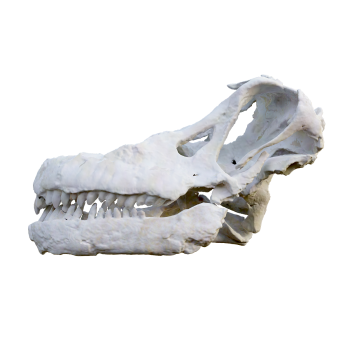
Fossil skull of Brachiosaurus

Fossil skull of Brachiosaurus

Brachiosaurus is a general term for the "Brachiosaurus genus" dinosaurs of the Jurassic period. The body length is 25 meters, the height is 15 meters, the weight is 30 tons, the tail is thick and short, the head is small, the neck is long, and the appearance is similar to that of a giraffe; There are large claws on the inner side of the forefoot; The jaw is well-developed, with 52 teeth covering the upper and lower parts, and the edges of the teeth are sharp; Strong limbs; The nostrils grow on the top of the head. Named after its long forelimbs. The head is very small and it is a dinosaur with low intelligence. Living in North America during the late Jurassic period and North Africa during the early Cretaceous period. It inhabits grasslands filled with ferns, cycads, and wood thieves. Mild temperament, enjoys living in groups. Feed on leaves and tender branches. Often foraging together.
Fossil of upper half skull of upper dog

Fossil of upper half skull of upper dog

The largest species in the genus Canis, the Hydni, has a shoulder height of 1.2 meters and an estimated weight of 95-120 kilograms, which is twice the size of the North American gray wolf. The sturdy physique and tenacious collective strength made these terrifying animals a nightmare for many vegetarians in North America at that time. The emergence of the upper dog was due to the decline of the canine bear family, which allowed them to turn passive into active and deliver fatal blows to their opponents, thus replacing half of the dominance of canine bears. The Terridae subfamily not only suppressed the development of the Canidae family in North America, but also eliminated its own ancestral group, led by the Osborn dog, which can weigh up to 50 kilograms.
Fossil skull of woolly rhinoceros

Fossil skull of woolly rhinoceros

The woolly rhinoceros is a mammal belonging to the family Rhinocerotidae in the order Neodactyla. The woolly rhinoceros is an extinct species of rhinoceros, named after its thick and dense fur covering its entire body. The woolly rhinoceros has strong bones, a long and large skull, and a head and neck that droops downwards; There is a rhinoceros horn on both the forehead and nose bones. The woolly rhinoceros has a body length of about 4 meters and a shoulder height of about 2 meters. It is covered with warm long hair and thick fur, and has a thick layer of fat under its skin. Like mammoths, they are all ice age animals that adapted to the cold climate and have traveled throughout the northern part of the Eurasian continent. They mainly inhabit the Eurasian grasslands and feed on shrubs and grasses grown in cold climates.
Fossil skull of wolf lizard beast

Fossil skull of wolf lizard beast

The wolf lizard (genus name: Inostrancevia), also known as the Inostrancevia, is a genus of theropod animals in the order Theropoda. It is a quadrupedal animal with four limbs standing upright below its body. The skull is 45 centimeters long and approximately 1 to 4.3 meters in length, with strong muscle attachments on the bones. Compared to other more primitive theropod animals such as the Bamo crocodile, the wolf lizard has smaller eye sockets and larger temporal fenestrae. Fossils were discovered in Sokolki, North Dvina River basin, Arkhangelsk Oblast, Russia. Wolf lizards lived in the Late Permian period 251 million years ago. South Africa has also discovered wolf lizards, which have been named African wolf lizards.
Argentine dragon head bone fossil

Argentine dragon head bone fossil

Argentinosaurus belongs to the Titanosaur class of sauropod dinosaurs, and its name is very simple, meaning a dinosaur discovered in Argentina. Survival period: 100 million years ago, mid Cretaceous Albian stage -93 million years ago, late Cretaceous Senonian stage. It is one of the largest land dinosaurs discovered. It is one of the largest animals that once roamed the earth, with a height of 12 meters and a length of 42 meters. Among all modern organisms, only the fragile double chambered dinosaur is longer than it. There are some other dinosaurs that are as long as the Argentinosaurus, and some that are taller than it. However, Argentinosaurus is still much heavier than other dinosaurs, possibly weighing up to 94 tons.
Nickelosaurus skull fossil

Nickelosaurus skull fossil

Nicrosaurus is a genus of sauropods in the order Ceratopsiformes. Their appearance and lifestyle may resemble crocodiles, but they are not closely related to crocodiles and are the result of parallel evolution. The main difference between Nicosaurus and crocodiles lies in the position of their nostrils. Nicosaurus' nostrils are located on the forehead, while crocodiles' nostrils are located at the end of their mouth and nose. It is a herbivorous dinosaur.
Dome shaped dinosaur skull fossil

Dome shaped dinosaur skull fossil

Camarasaurus is an extinct sauropod dinosaur. It is the most common large sauropod dinosaur in North America, with an adult body size of about 20 meters long and a weight of 15-50 tons. Compared to other long necked dinosaurs, its neck is much shorter and its tail is also shorter, making its physique appear more robust and sturdy. It is one of the most famous dinosaurs in North America. The Latin meaning of its name is a dome shaped reptile. They belong to vegetarian dinosaurs and lived in the late Jurassic period, dating back 155 to 145 million years ago. Compared to other tall relatives in the sauropod family, the dome dragon appears relatively short.
Fossil skull of Protoceratops

Fossil skull of Protoceratops

Protoceratops, a ceratopsian dinosaur, lived in the late Cretaceous period (approximately 100-65 million years ago). It is a short legged quadruped animal with a body length of 2 meters and a weight of nearly 400 kilograms. The teeth are long and sharp. There are bony folds in the neck and large jaw muscles. May rely on palm leaves as a staple food. A quadrupedal dinosaur with a large head shield behind its head and no horns. Living in groups. They gave birth to small dinosaurs in their own nests. The heads of Protoceratops are of medium size, so they are relatively intelligent. It has a very similar appearance to the famous Triceratops, but is smaller in size and does not have long horns on its head.
Fossil skull of terror jaw pig

Fossil skull of terror jaw pig

The terror pig, also known as the terror pig, has a slightly larger body size than the giant pig and the complete toothed pig, and is an extremely large species in the giant pig family. Between 5 and 23 million years ago, the terror pig was the largest member of the Auchenipteridae family in history. It had huge tusks and jawbones, was an omnivorous species, and had a body size similar to that of a rhinoceros. It was more ferocious than modern wild boars and was named after its previous name, Dinohyus, which means "terror pig" in Greek. Their living habits are similar to those of ancient giant pigs and porcupines. The staple food of the terror pig is plants, but it also often eats decay or attacks small animals, as well as snatching food from small carnivores.
Fossil skull of saber toothed tiger

Fossil skull of saber toothed tiger

Thylacosmilus is an extinct marsupial mammal that lived in prehistoric South America. It was a large terrestrial carnivore that once lived and competed with the saber toothed tiger. But the saber toothed tiger is actually a marsupial mammal, not belonging to the feline family, and even not to the carnivorous order. It only resembles the saber toothed tiger in appearance due to convergent evolution. Living in the Quaternary period of the Tertiary period. The body size is not very large, the largest of which is equivalent to the size of a jaguar and four times that of a pack wolf. He was one of the larger meat beasts in the southern cuisine at that time, with developed sword teeth and a strong body.
Dinosaur skull fossil

Dinosaur skull fossil

Plateosaurus is an ancient dinosaur from the Triassic period, which lived between 222 million and 200 million years ago. It was the first giant dinosaur to appear on Earth. Before the appearance of the Banosaurus, the largest herbivore had a body size as big as a pig, while the Banosaurus was much larger, with a body the size of a bus. It is an ancient dinosaur that lived 210 million years ago during the Late Triassic period. It has a body length of 6-8 meters, a height of 3.6 meters, and a weight of about 5 tons. According to archaeological research, it was the first giant dinosaur that lived on Earth and ate plants.
Fossil of the upper half skull of the swollen dragon

Fossil of the upper half skull of the swollen dragon

The swollen headed dragon is a member of the thick headed dragon family in the order Ornithischia of the class Sauropods. The swollen headed dragon, also known as the thick headed dragon, has a thick bone plate on its head, which can reach a thickness of over 20 centimeters, and is raised high like a tumor. The body length is 4-6 meters and the weight is 0.5-4 tons. The area around the head and nose tip are also covered with small bone tumors, and some have large and sharp spines behind the head. Living in the late Cretaceous period, mainly distributed in North America, inhabiting plains, deserts, and other environments. Sexually inclined to live in groups, males fight in the form of "heads", with the winner being the leader of the entire group and occupying the female dinosaur. A herbivorous dinosaur that feeds on fruits, leaves, and other food.
Fossil skull of Egyptian heavy footed beast

Fossil skull of Egyptian heavy footed beast

The scientific name of the Egyptian heavy footed beast was taken in honor of the queen of Ptolemy II, Arsinoe II, as the initial fossils were found near the ruins of her palace. The bones found here are the only complete, and the most famous species is the Qi's heavy footed beast. It is about 4.5 meters long, 2.5 meters high, and weighs about 4 tons. The most prominent feature of the Egyptian heavy footed beast is a pair of giant horns protruding from its nose. It has 44 strong teeth in its mouth, which can easily chew rough and hard plants. The Egyptian heavy footed beast evades the hunting of most predatory animals with its massive body. The era of life was approximately 37 to 23 million years ago.
Fossil upper skull of ancient giant turtle
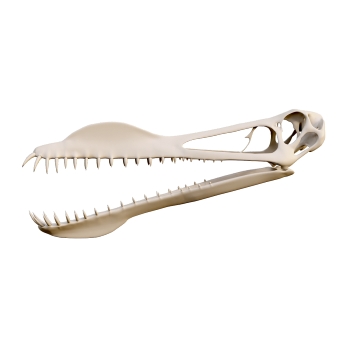
Fossil upper skull of ancient giant turtle

The ancient giant turtle, the largest sea turtle in history. Also known as the Emperor Turtle, Ancient Turtle, Terror Turtle, Mock Turtle, or Ancestral Turtle, it is an extinct genus of sea turtle and the largest sea turtle in history. It is similar to the current leatherback turtles, both of which live in the sea. The body shape is very similar to that of today's sea turtles, with a beak that has huge biting power, and may feed on animals such as squid. The first fossil of the ancient giant turtle genus was discovered in 1895, and this fossil is very famous. On the one hand, it is huge, and on the other hand, it lacks a right hind foot, which is likely to have been bitten off by some giant predator.
Fossil skull of pterosaur

Fossil skull of pterosaur

Pterodactylus, a pterosaur of the late Jurassic period, is characterized by a lightweight and compact skull composed of thin, hollow bones. Its first finger is particularly elongated to support membrane wings, and its hind limbs are short. All members of the Pterodactylidae family have short tails and long heads. Some species of pterosaurs have a body size similar to sparrows; Others can be as big as eagles, with wings extending up to 30-70 centimeters, feeding on insects, and some may forage for fish. The entire group of pterosaurs is a suborder of pterosaurs. In terms of classification, it does not truly belong to dinosaurs, but is only a close relative of dinosaurs.
Fossil skull of Heterodontosaurus

Fossil skull of Heterodontosaurus

Heterodontosaurus, also known as Heterodontosaurus or Spinosaurus, is a carnivorous animal resembling a mammal that lived during the Permian period. Heterodontosaurus has a close relationship with mammals, but a distant relationship with dinosaurs, lizards, birds, etc. Its fossils are found in North America and Europe. Heterodontosaurus is a carnivorous ancient organism from the Permian period. The general public associates Heterodontosaurus with a dinosaur, but it is not actually a dinosaur. More precisely, they are classified as Panosauriformes. Although it resembles a lizard in appearance, Heterodontosaurus has a closer relationship with mammals and is farther away from true reptiles such as dinosaurs, lizards, birds, etc.
1 2 Next